
 Language
 English
 عربى
عربىIndustry News
Modern electrical infrastructure demands conductor materials that balance performance, safety, and cost-efficiency. Aluminum alloy cables have emerged as a compelling answer to these demands, offering a sophisticated upgrade over both traditional pure aluminum and copper conductors. By engineering trace additions of iron, copper, magnesium, and manganese into aluminum, manufacturers have created a cable material that overcomes the historical weaknesses of pure aluminum while preserving its most valuable characteristic — low weight. Whether you are planning a large-scale industrial installation or a commercial building project, understanding the distinctions between single core aluminum alloy cables and multi-core aluminum alloy cables is essential to making the right specification decision.
Content
What Makes Aluminum Alloy Cables Different
Pure aluminum has long been used as an electrical conductor due to its availability and light weight, but it carries significant mechanical drawbacks. It is prone to cold flow — a gradual deformation under sustained pressure — and creep, which causes the conductor to slowly expand and contract under thermal cycling. Both phenomena lead to loose connections over time, which is a well-documented cause of electrical fires in older aluminum-wired buildings.
Aluminum alloy cables solve these problems at the metallurgical level. The addition of iron improves creep resistance dramatically, while magnesium and copper contribute to tensile strength and overall mechanical robustness. Manganese refines the grain structure of the alloy, further improving durability under mechanical stress. The result is a conductor that maintains secure, stable connections throughout its service life — even after thousands of thermal expansion and contraction cycles.
Beyond safety, aluminum alloy cables retain the weight advantage of pure aluminum. A comparable aluminum alloy cable weighs approximately half as much as an equivalent copper cable. On large projects involving hundreds of meters of cable runs, this translates into significantly reduced transportation costs, easier handling during installation, and less structural loading on cable trays and supports.
Single Core Aluminum Alloy Cables Explained
Single core aluminum alloy cables consist of one conductor, either solid or stranded, enclosed within an insulating jacket. Their straightforward construction makes them highly versatile and particularly well-suited to applications where current-carrying capacity per conductor must be maximized without the complexity of a bundled design.
Key Characteristics
- Higher current-carrying capacity compared to equivalent multi-core designs, because heat dissipation is not shared between adjacent cores
- Greater flexibility in routing — individual cores can be run through separate conduits to optimize thermal performance
- Easier to terminate and joint at large cross-sections, as each conductor is handled independently
- Preferred for high-voltage distribution, underground feeder circuits, and substation connections
In practice, single core aluminum alloy cables are commonly specified for power distribution in utility networks, industrial substations, and large commercial facilities where three-phase power is distributed through separate phase conductors. They are also widely used as service entrance cables entering buildings from utility supply points. The alloy construction ensures that the mechanical integrity of the conductor is maintained even when the cable is pulled through conduits or bent around corners during installation.
Multi-Core Aluminum Alloy Cables Explained
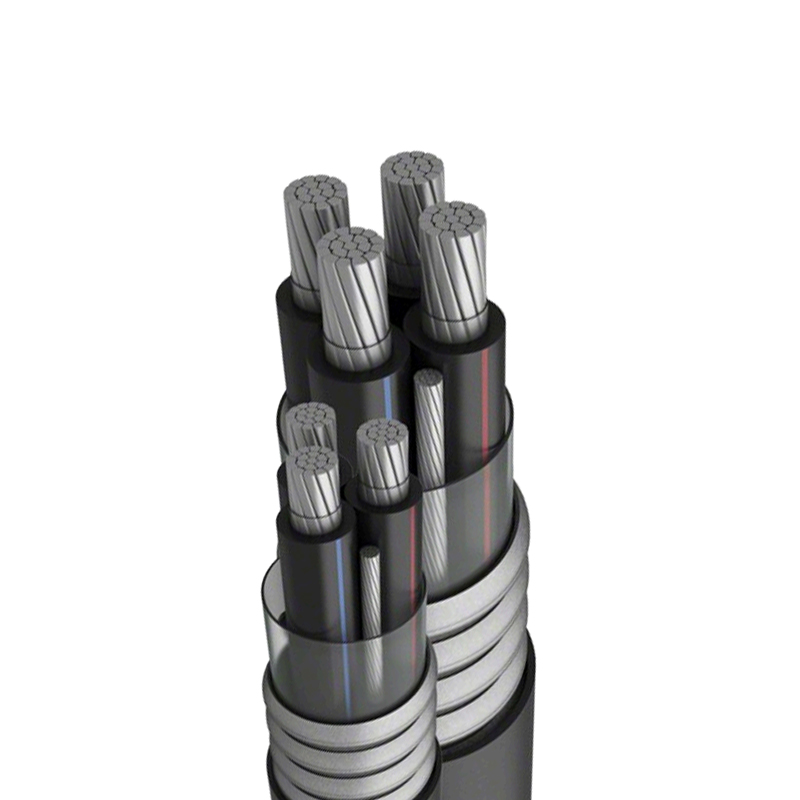
Multi-core aluminum alloy cables combine two or more insulated conductors within a single outer sheath. This integrated construction simplifies wiring by bundling phase, neutral, and earth conductors together, reducing installation time and making cable management far more straightforward in complex environments.
Key Characteristics
- Convenient all-in-one construction that reduces the number of individual cables to be routed and terminated
- Reduced installation labor costs, particularly in buildings with complex internal distribution networks
- Available in configurations including 2-core, 3-core, 4-core, and 5-core designs to suit different circuit requirements
- Outer armor and sheathing options provide additional mechanical protection in exposed or underground installations
Multi-core aluminum alloy cables are frequently chosen for branch circuit distribution within commercial buildings, industrial facilities, and residential developments. Their compact design also makes them suitable for direct burial applications when specified with appropriate moisture-resistant and armored outer jackets. The alloy conductor's improved elongation properties are particularly valuable here — cables must flex and shift slightly as soil settles over time, and the enhanced mechanical performance of the alloy prevents conductor fracture under these stresses.
Single Core vs Multi-Core: Choosing the Right Configuration
The selection between single core and multi-core aluminum alloy cables depends on several project-specific factors. The table below summarizes the primary considerations to guide the decision:
| Factor | Single Core | Multi-Core |
| Current Capacity | Higher per conductor | Reduced due to thermal grouping |
| Installation Speed | Slower (multiple runs) | Faster (single cable run) |
| Routing Flexibility | High | Moderate |
| Best Application | High-voltage feeders, substations | Branch circuits, building distribution |
| Cable Management | More complex | Simpler |
Installation Best Practices for Aluminum Alloy Cables
While aluminum alloy cables are significantly more forgiving than pure aluminum during installation, following correct practices remains critical to long-term performance. The most important step is proper termination. Aluminum alloy conductors must be terminated using connectors specifically rated and listed for aluminum or aluminum alloy use. Using copper-only connectors can result in galvanic corrosion at the joint interface, increasing resistance and creating potential hot spots.
Applying an appropriate antioxidant compound to the conductor strands before insertion into the terminal helps prevent oxide layer formation on the alloy surface. Although the alloy's oxide layer is less problematic than that of pure aluminum, this practice further ensures a low-resistance, durable connection. Terminal screws should be torqued to the manufacturer's specified values using a calibrated torque wrench — both under-tightening and over-tightening compromise joint integrity.
During pulling and routing, care should be taken not to exceed the cable's minimum bend radius. While the improved elongation and tensile strength of aluminum alloy cables give them better resistance to installation damage than pure aluminum, sharp bends or kinks can still compromise insulation integrity. Following manufacturer guidelines for maximum pulling tension is equally important, especially for longer single core runs through conduit systems.
Long-Term Value and Sustainability
From a lifecycle perspective, aluminum alloy cables offer compelling economic advantages. Their initial cost is substantially lower than equivalent copper cables, and the weight savings reduce secondary costs across the project — from freight and rigging to cable tray sizing and structural support design. Over the decades-long service life of a cable installation, the elimination of creep-related maintenance interventions and the associated risk of connection failures adds further value.
Sustainability is an increasingly important consideration in electrical specification decisions. Aluminum is one of the most abundantly available and highly recyclable metals on Earth. At end of life, aluminum alloy cables can be recovered and recycled with high efficiency, contributing to circular economy goals and reducing the environmental footprint of electrical infrastructure projects. For engineers and project owners seeking to align with green building standards, this recyclability adds another dimension to the case for aluminum alloy conductor systems over copper alternatives.
Aluminum alloy cables — whether specified as single core aluminum alloy cables for high-capacity feeder applications or multi-core aluminum alloy cables for flexible distribution networks — represent a mature, well-proven technology that deserves serious consideration in any modern electrical project. Their combination of enhanced mechanical performance, connection safety, weight efficiency, and long-term economic value makes them one of the most practical conductor choices available today.