

 Language
 English
 عربى
عربى
Home / News / Industry News / Aluminum Alloy Cable: Composition, Advantages, and How to Choose the Right One
Industry News
When engineers and procurement teams evaluate conductor materials for power distribution projects, aluminum alloy cables have become an increasingly compelling choice. Unlike pure aluminum cables, which carry well-documented weaknesses in mechanical strength and long-term connection stability, aluminum alloy cables are engineered at the material level to overcome those limitations — while retaining the lightweight, cost-effective nature that makes aluminum attractive in the first place.
This guide breaks down what aluminum alloy cable actually is, why its performance profile differs so significantly from both pure aluminum and copper, and how to select the right product for your specific application.
Content
Aluminum alloy cable uses a conductor that is not pure aluminum, but rather an engineered alloy formed by introducing precise quantities of trace elements — typically iron, copper, magnesium, and manganese — into a pure aluminum base. The resulting material is then processed through controlled alloying and heat treatment techniques to stabilize its microstructure.
The distinction matters more than it might appear. Pure aluminum conductors (with aluminum content above 99.5%) offer good conductivity but suffer from inherent mechanical fragility, susceptibility to creep under sustained load, and poor resistance to repeated bending. The alloy formulation addresses each of these weaknesses systematically, producing a conductor that behaves more like copper in mechanical terms while staying far closer to aluminum in weight and cost.
The most widely adopted standard in this category is the AA-8000 series (per ASTM B800/B801), which is recognized under the U.S. National Electrical Code (NEC) for use in building wiring. In the Chinese market, the YJLHV 8030 series follows a comparable alloy specification and is commonly used in medium-voltage distribution systems.
The performance gap between aluminum alloy and pure aluminum conductors is significant enough to change the engineering calculus for most projects. The improvements are concentrated in four areas.
Pure aluminum conductors have relatively low tensile strength, which makes them vulnerable to damage during installation — particularly at bends, terminations, and pull-through points. Aluminum alloy conductors achieve tensile strength improvements of approximately 30% over pure aluminum, along with substantially higher elongation rates. In practice, this means the conductor can absorb mechanical stress without cracking or breaking, reducing installation-related failures significantly.
The bending radius requirement is a practical concern during installation in confined spaces. Pure aluminum cables typically require a minimum bending radius of 10 to 20 times the outer cable diameter. Aluminum alloy cables reduce this to approximately 7 times the outer diameter — comparable to copper cable behavior — making routing through tight conduit runs, junction boxes, and panel connections far more manageable. To understand how this flexibility holds up under ongoing mechanical stress and vibration in service, see our article on how aluminum alloy cables handle mechanical stress.
Creep — the gradual, permanent deformation of a conductor under sustained compressive or thermal load — is one of the most serious failure modes in pure aluminum wiring. Over time, creep causes conductor material to flow away from terminal contact points, loosening connections and creating resistance hot spots that can lead to fire. The addition of iron to the alloy matrix produces high-strength grain structures that dramatically reduce creep rates, even during extended periods of overload or elevated temperature. This is the single most safety-critical advantage of aluminum alloy over pure aluminum in building wiring applications.
All aluminum forms a protective oxide layer on exposure to air, giving it inherent corrosion resistance. Aluminum alloys go further: the addition of rare earth elements and other trace components enhances resistance to electrochemical corrosion — the galvanic degradation that tends to develop at connection joints between dissimilar metals over time. This is particularly relevant in coastal, industrial, and underground installations where moisture and chemical exposure are ongoing factors.
Copper remains the reference conductor material in most electrical specifications, but the performance gap between copper and modern aluminum alloy has narrowed considerably. The differences that remain are largely matters of geometry and connection hardware rather than fundamental reliability.
| Property | Aluminum Alloy Cable | Copper Cable |
|---|---|---|
| Conductor density | ~2.7 g/cm³ | ~8.9 g/cm³ |
| Weight vs. copper (same ampacity) | ~50% lighter | Reference |
| Required cross-section (same ampacity) | ~1.1–1.2× larger | Reference |
| Conductivity (volume basis) | ~61% of copper | Reference |
| Conductivity (weight basis) | ~200% of copper | Reference |
| Creep resistance | High (alloy grain structure) | High |
| Material cost | Significantly lower | Higher |
The cross-section requirement — aluminum alloy needs roughly 10–20% more conductor area than copper for the same current-carrying capacity — means cable and conduit dimensions are slightly larger. However, the weight reduction of approximately 50% translates directly into lower structural support requirements, lower freight costs, and faster, less labor-intensive installation. For large-scale projects involving hundreds or thousands of meters of cable runs, these savings are substantial.
On the connection side, aluminum alloy cables require copper-aluminum transition terminals rather than standard copper terminals. The terminal dimensions — particularly length — run approximately 30% larger than their copper counterparts, so electrical enclosures and panel layouts must account for the additional termination space.
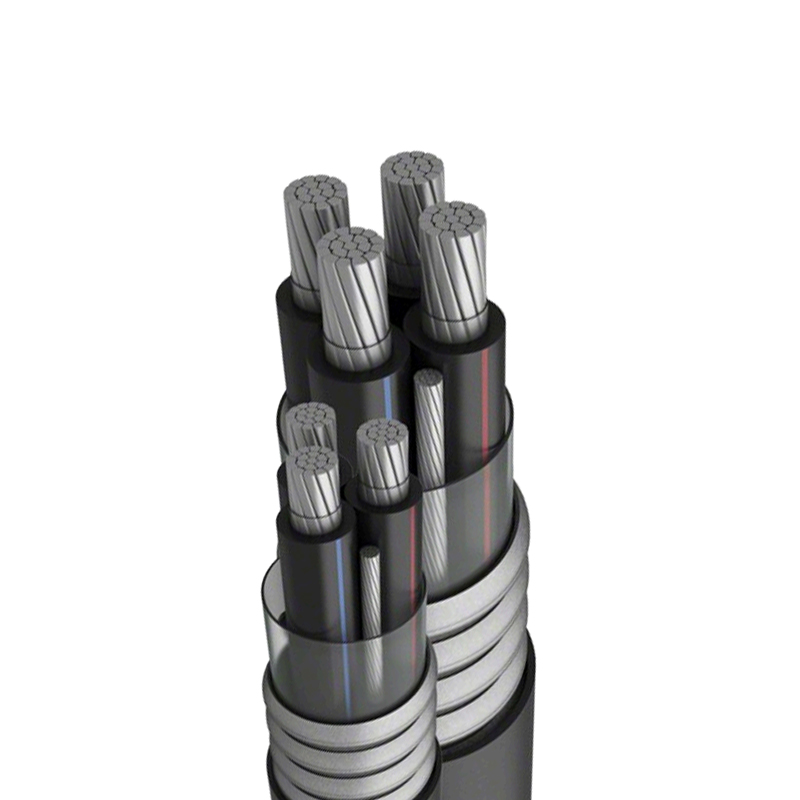
Aluminum alloy cable is well suited to a wide range of medium- and large-scale power distribution scenarios. Its strongest case is made wherever long runs, high ampacity requirements, and installation efficiency are simultaneously important.
Note that for fire-resistant circuits, high-temperature environments, and public facilities with stringent safety classifications, local codes may still mandate copper conductors. Always verify applicable regulations before specifying aluminum alloy cable for life-safety systems.
Selecting the correct aluminum alloy cable involves more than matching ampacity. Several parameters determine whether a given product will perform reliably over its service life.
Aluminum alloy cable represents a mature, proven technology — not a compromise. When properly specified and installed, it delivers the connection stability, mechanical durability, and long-term safety that modern power distribution demands, at a cost structure that copper simply cannot match.




Copyright © 2025 Wuxi Sanxin Cable Co., Ltd.
All Rights Reserved.
High Voltage Power Cables Manufacturers
Low Voltage Power Cables Factory
