

 Language
 English
 عربى
عربى
Home / News / Industry News / Lightweight Aluminum Cable: Weight Advantages, Performance, and Best Applications
Industry News
In electrical engineering, weight is rarely discussed as a primary performance metric — yet it shapes project economics, structural requirements, and installation timelines in ways that add up quickly. Lightweight aluminum cable weighs approximately 50% less than copper cable of equivalent current-carrying capacity, and that single fact has driven aluminum's adoption across utility grids, commercial buildings, and large-scale infrastructure projects worldwide.
What has changed in recent years is the quality of the aluminum being used. Modern aluminum alloy conductors have resolved the mechanical weaknesses that gave early aluminum wiring a poor reputation, making lightweight aluminum cable a genuinely robust solution rather than simply the cheaper option.
Content
The impact of conductor weight extends well beyond what gets lifted on a job site. It touches nearly every phase of a cable project.
The weight advantage of aluminum over copper is rooted in material physics: aluminum has a density of approximately 2.7 g/cm³, compared to copper's 8.9 g/cm³ — meaning copper is more than three times as dense by volume.
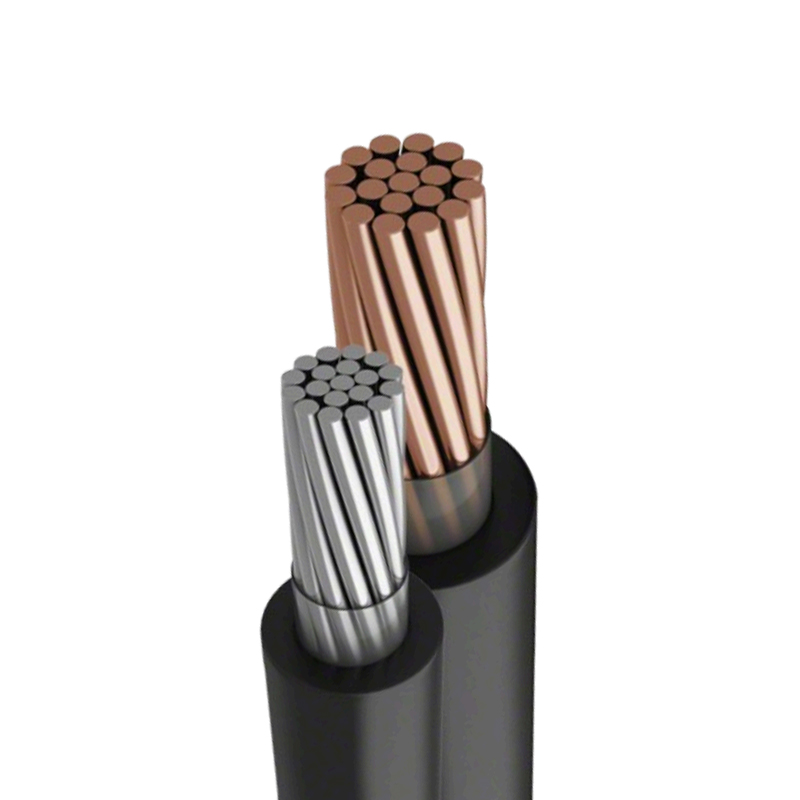
Because aluminum is less conductive than copper on a volume basis (roughly 61% of copper's conductivity), a larger cross-section is needed to carry the same current. In practice, an aluminum cable needs approximately 1.1 to 1.2 times the cross-sectional area of a copper cable to match its ampacity. Even accounting for this size increase, the aluminum cable still ends up lighter — typically by around 50% — because the density difference is so large that it more than compensates for the extra material volume.
On a conductivity-per-unit-weight basis, aluminum actually outperforms copper by a factor of roughly 2:1. This is why utility companies have used aluminum for high-voltage transmission lines for decades: for the same power-carrying capability, you move far less mass, which is critical when spanning long distances between towers.
| Metric | Lightweight Aluminum Cable | Copper Cable |
|---|---|---|
| Material density | 2.7 g/cm³ | 8.9 g/cm³ |
| Required cross-section (same ampacity) | ~1.1–1.2× larger | Reference |
| Cable weight (same ampacity) | ~50% of copper | Reference |
| Conductivity / unit weight | ~200% of copper | Reference |
| Material cost | Substantially lower | Higher |
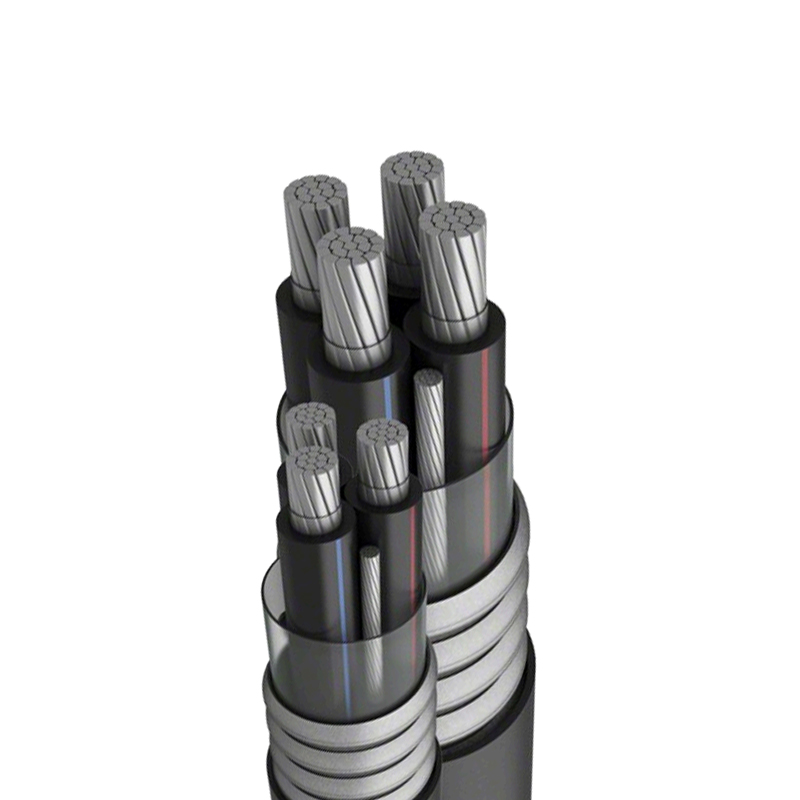
For many years, the conversation around lightweight aluminum cable was complicated by a legitimate concern: early aluminum building wire had a history of connection failures. Pure aluminum is soft, prone to creep (gradual deformation under sustained load), and expands and contracts significantly with temperature cycling. Over time, these factors caused terminations to loosen, creating resistance hot spots and, in serious cases, fire risk.
Modern aluminum alloy cables have addressed these problems at the material level. By introducing trace amounts of iron, magnesium, copper, and other elements into the aluminum matrix, alloy manufacturers achieve:
The result is a conductor that retains aluminum's defining weight and cost advantages while matching copper's reliability profile in most commercial and industrial applications. The lightweight benefit is no longer a trade-off — it is an additional advantage layered on top of a performance foundation that stands on its own.
Lightweight aluminum cable performs best in applications where long runs, high current loads, and installation practicality are all important. The following scenarios represent its strongest use cases.
This is where aluminum's weight advantage is most decisive. Aluminum conductor cables can span distances that would be structurally and economically impractical with copper, because lower conductor weight means less sag, reduced tower loading, and viable longer spans between support structures.
Feeder cables, rising mains, and main distribution runs in high-rise office towers, warehouses, hospitals, and manufacturing facilities represent exactly the kind of long, high-ampacity runs where aluminum's weight and cost savings compound. Power cables with aluminum alloy conductors are now standard specification in many large commercial projects in markets where copper pricing is volatile.
Solar installations — particularly ground-mounted utility-scale arrays — require extensive cable runs across large areas. Lightweight aluminum cable reduces both the direct material cost and the structural cost of cable management systems. Aluminium solar cable products are specifically designed for the UV exposure, temperature cycling, and outdoor installation conditions typical in photovoltaic applications.
In renovation projects, the ability to pull lighter cable through existing conduit infrastructure — often with tighter bend requirements and longer runs than a new installation would specify — makes aluminum alloy cable a practical choice that copper cannot always match on installation feasibility alone.
The weight advantage is easy to realize on site. Capturing the long-term reliability advantage requires attention to a few installation details that differ from copper practice.
With the right termination practice, lightweight aluminum cable delivers decades of stable, low-maintenance service. The weight savings are immediate and visible from the first day of installation; the reliability payoff accumulates over the life of the system.




Copyright © 2025 Wuxi Sanxin Cable Co., Ltd.
All Rights Reserved.
High Voltage Power Cables Manufacturers
Low Voltage Power Cables Factory
